Shop the B's Custom Pedal Collection for The Meowdulator & MORE!
Rainger FX - Binary Pulsar
SKU Binary-Pulsar
$279.00
1
Rainger FX - Binary Pulsar
Product Details
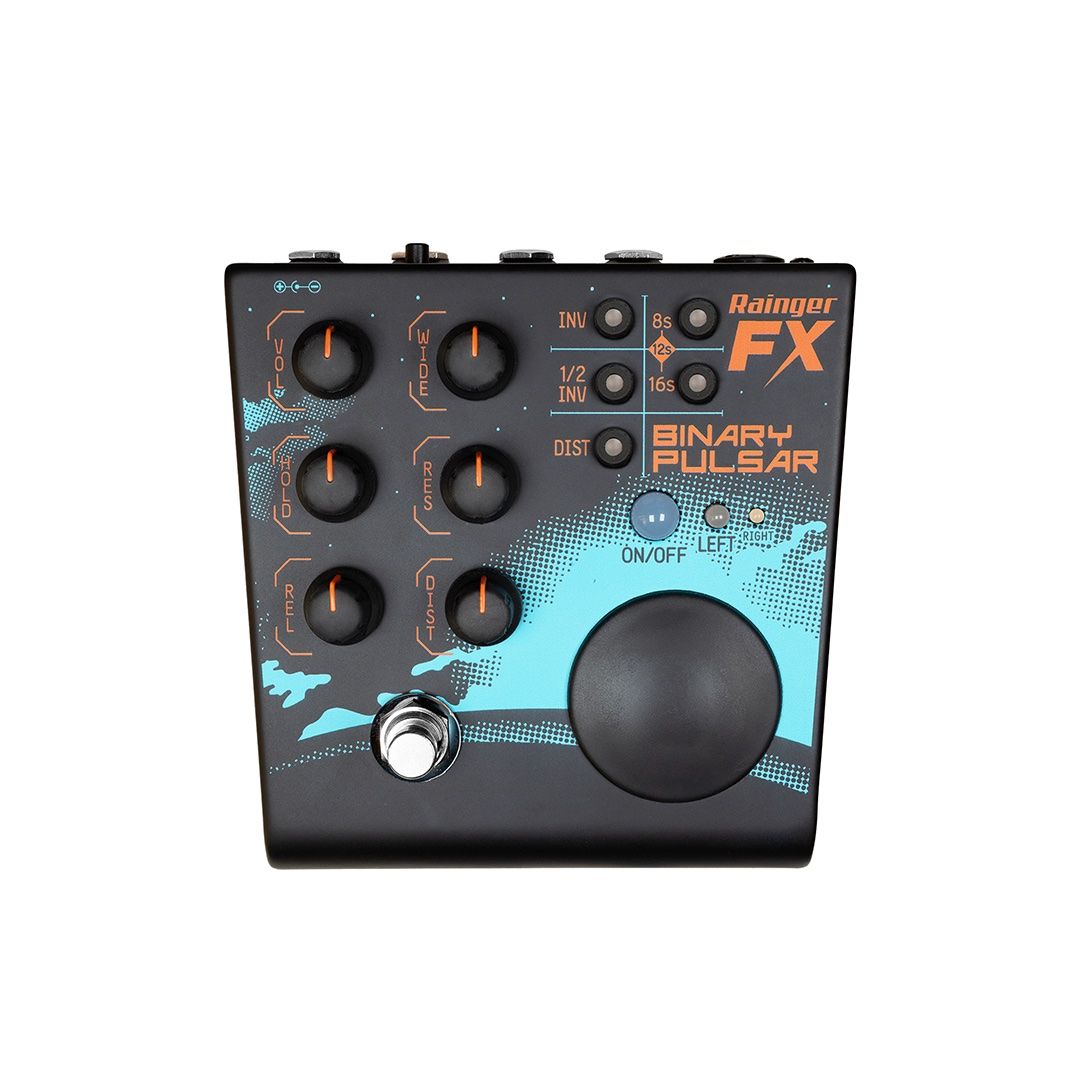
Rainger FX has always operated in its own strange corner of the effects world — weird in the best way, deeply musical, and built for players who want something genuinely different. The Binary Pulsar is a perfect example of that philosophy taken to a new level. This is Rainger's first stereo pedal, and they didn't ease into it. The Binary Pulsar is a sidechainer, panner, and tremolo rolled into one compact unit, and the range of motion it covers is genuinely startling. Run it between two amps and it comes alive — pulses bouncing between speakers, stereo dips that feel like the room is breathing, choppy rhythmic effects that lock in tight with your playing. It's the kind of pedal that makes you rethink what tremolo even means. At its core, the Binary Pulsar does what tremolo does — modulates your volume rhythmically — but the controls here push it well beyond that. The **Res** knob adds a resonant filter to the sweep, giving the effect a throaty, almost synth-like character. The **Wide** control delays the right channel output, opening up stereo dip effects and a loose, swinging feel that's hard to describe and impossible to ignore once you've heard it. Flip the **INV** switch and instead of dips, you get pulses — a fundamentally different feel that cuts through a mix like a strobe light through fog. The **½ INV** switch inverts one side of the stereo output, and the results are massive — wide, disorienting, and deeply satisfying. Then there's the built-in distortion and flanging combination, triggered by the **Dist** button and shaped with its own volume knob. It's not a clean, surgical flange — it's gritty and slightly unhinged, which suits the character of this pedal perfectly. And when you want to take the digital edge off entirely, the **Warm** switch kicks in an analog overdrive circuit that rolls off the high end and pushes the mids forward. Suddenly the whole thing feels thicker, older, more organic — like a vintage unit that's been modified by someone who knew exactly what they were doing. Sync options are where the Binary Pulsar separates itself from anything else on the market. You can drive it with internal tap tempo (two-press pad programming, with a correctible tap feature that's genuinely useful live), a CV/gate signal from a modular synth, the Rainger FX Snare Trap, or an external trigger via a mic input — XLR or quarter-inch. Feed it a kick drum signal and it sidechains to the beat. Feed it a gate from your modular and it becomes part of a larger system. From a 4s input, it generates rhythmic pulses in 4, 8, 12, 16, and 32 subdivisions. It's equally at home on a studio desk as it is on a pedalboard, and Rainger built the enclosure — a new custom design with rolled edges — to handle both. It's the kind of pedal that rewards experimentation. Studio producers will find it adds a new dimension to static mixes. Live players running stereo rigs will find it transforms a simple chord into something spatial and alive. And for anyone already working in the modular world, it slots in with a fluency that feels intentional. --- **Specifications:** - **Type:** Stereo sidechainer / panner / tremolo - **Signal Path:** All digital with switchable analog Warm circuit - **Enclosure:** Custom Rainger FX, rolled edge design - **Mounting:** Floor or desk - **Outputs:** Stereo (L & R); mono operation sums both outputs to left - **Inputs:** Stereo instrument input; mic input via XLR or ¼" - **Sync Sources:** Internal tap tempo, CV/gate (modular synth), Rainger FX Snare Trap, external trigger/mic - **Controls:** Res (resonant filter), Wide (right-side delay), Volume (dist circuit), INV switch, ½ INV switch, Warm switch, Dist button, Tap Tempo pad - **Pulse Subdivisions (from 4s input):** 4s, 8s, 12s, 16s, 32s - **LED Indicators:** Tempo and record status - **Dimensions:** 127mm wide × 134mm deep × 66mm high - **Current Draw:** 165mA
